


SEO vs. AEO: What’s the Difference?
For years, businesses have been posing one main question to marketing agencies like DCM:
How do I get my business to show up in search results?
And in years past, the answer would usually follow the same list of how to optimize content so it ranks higher for your target keywords in search engines like Google.
But the typical way of getting information by clicking through a list of links in a Google results page quickly giving way to AI-generated resources like search summaries, conversational tools, voice assistants, and more.
This doesn’t mean businesses need to throw out everything they know about search engine optimization (SEO), but it does mean it’s time to learn about another acronym: AEO, or Answer Engine Optimization.
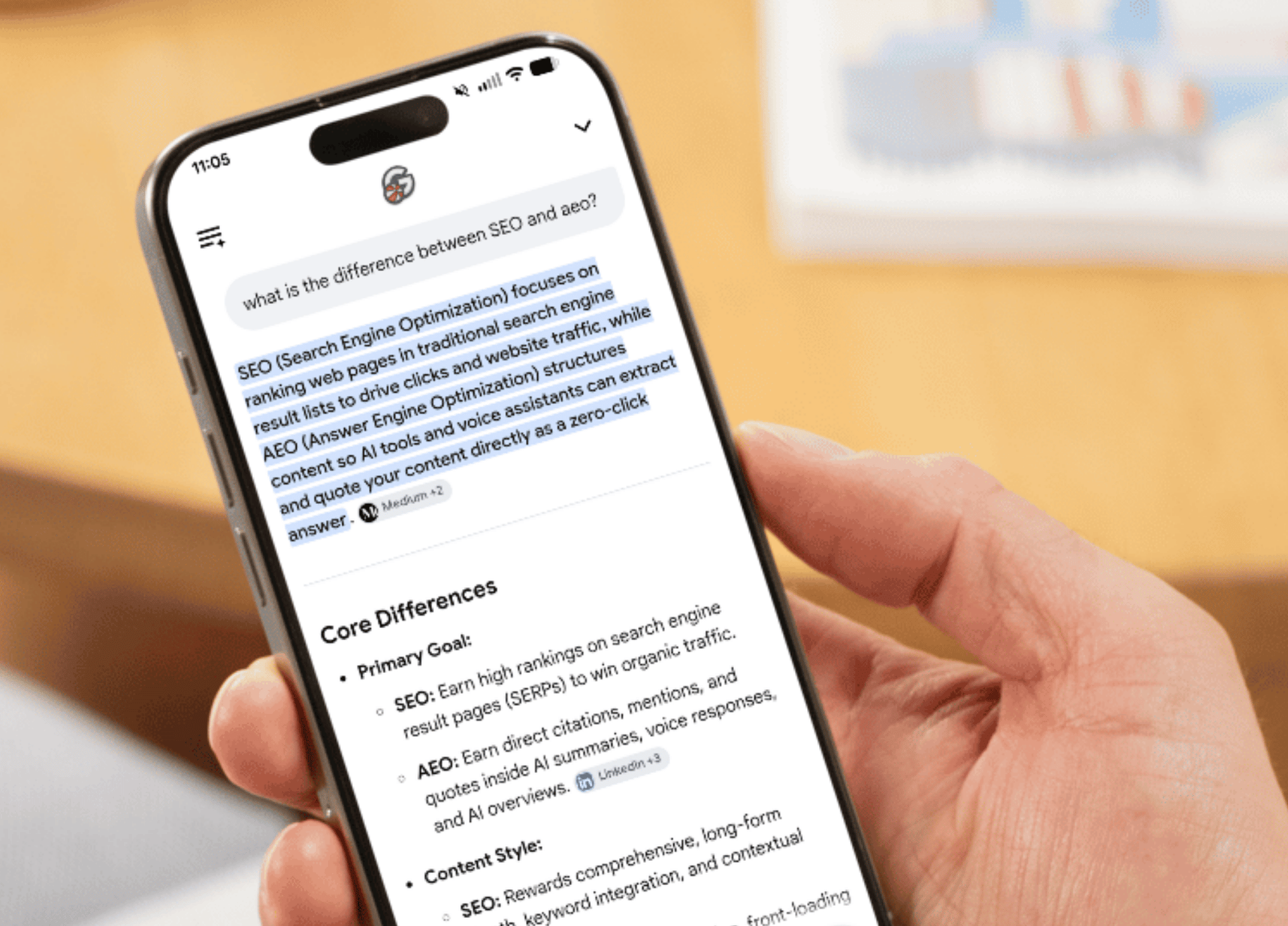
SEO and AEO are related, but they optimize for different outcomes.
SEO helps search engines find, understand and rank your content.
AEO makes it easier for search and AI platforms to extract, understand and use your content to answer a specific question.
Ok, great, but what does that actually mean? And how businesses should be thinking about both?
We’re so glad you asked…
What Is SEO?
Search engine optimization (SEO) is the practice of improving your website and content so search engines can discover, understand, and catalog it based on relevance to the search query.
We could write an entire separate blog about SEO (and we have!). As with most things marketing, there are different schools of thought on what approaches are most effective, but the highlights generally include:
➞ Understanding search intent + keywords. This is where understanding your clients’ challenges and the language they use to talk about them is essential.
➞ Publishing useful, relevant content. If you have an event company, your content better talk about events, not your take on the latest trends in gardening.
➞ Being mindful of site structure and technical performance. Make your website and content easy to navigate, pay attention to site speed and performance, and yes, stop ignoring those Google Analytics reports!
➞ Including thoughtful, relevant internal/external links and authority. Add high quality relevant links (to your site or others) to support and strengthen your content’s authority.
Here’s the DCM take: Good SEO is about consistently creating useful content around topics you actually know, making that content easy for people to consume, and building your authority over time. And as we’ll get into below, those fundamentals become even more important when we start talking about AEO.
All of these tactics can move you toward the goal of earning higher visibility in search results and ultimately driving qualified traffic to your website. (Hello, more leads and revenue!)
What Is AEO?
Answer engine optimization (AEO) is the practice of structuring and strengthening content so search engines and AI-powered platforms like ChatGPT, Claude and Gemini can confidently use it to answer users’ questions.
AEO generally favors content that:
➞ Answers specific questions clearly and directly
➞ Uses natural, conversational language
➞ Is organized around how people actually ask questions
➞ Shows credible expertise and specificity
➞ Makes important information easy for machines and humans to understand (i.e. you want to show up in the “talk to me like I’m a 5 year old” prompts)
Before you start turning every headline on your website into a question, an important distinction:
Creating content for AEO is more than just sprinkling questions and keywords into existing copy or “writing for robots”.
The content still has to be useful, authoritative, and written for the actual person asking the question (who, ideally, is someone you want to do business with 😉).
SEO vs. AEO: What’s the Difference?
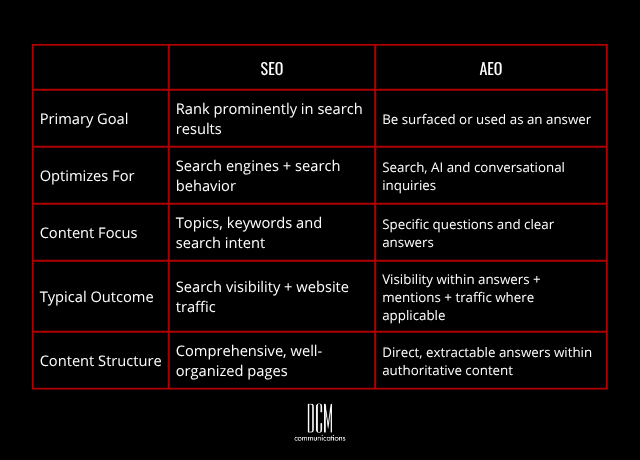
Let’s do a quick comparison chart to see the differences side by side:
A simpler way to understand the difference between the two is this:
SEO asks “How do we help this page get found?”
AEO adds: “How do we make this content easy to understand and use as an answer?”
In other words, getting found is still important. Now, being understood matters just as much.
Do You Need SEO or AEO?
Yes 😆
In 2026 and beyond, you need both.
But hear this: AEO does NOT replace SEO.
Many of the things that make content valuable for traditional search, like clear structure, relevance, authority (this is where PR comes in), useful information and a technically sound website, also help AI-powered platforms understand it.
The difference is that as a small business owner you now need to think beyond whether your website ranks and ask whether your expertise can actually be recognized and served up as an answer.
Instead of choosing between SEO and AEO, the goal is to create content worth finding and worth citing.
A simpler way to understand the difference between the two is this:
SEO asks “How do we help this page get found?”
AEO adds: “How do we make this content easy to understand and use as an answer?”
In other words, getting found is still important. Now, being understood matters just as much.
What Does SEO + AEO Mean for Your Content Strategy?
While search behavior is definitely changing, the basics of useful content aren’t. You don’t need to chase every new acronym or completely reinvent your content strategy every time Google (or ChatGPT) changes something.
Your business should still create content that is focused on what your clients care about and what you actually know.
The difference now is making sure that expertise is structured in a way both people and AI-powered platforms can actually understand and use.
A strong content strategy needs to focus on content that works for SEO and AEO.
Don’t know where to start? We do! Let’s talk and create a content strategy that will help get your expertise found, understood, and used, wherever your audience is searching.


The Top 4 Mistakes We See With Using AI to Repurpose Content
AI makes it easy to repurpose content but there are four mistakes we see

2026 Email Marketing: What to Expect and How to Adapt
Learn the top email marketing trends for 2026, including segmentation, subject lines, and human-centered
What I Learned from the GURU Conference: Real Talk on Email Marketing in the Age of AI
AI can’t replace real connection. Get 5 actionable takeaways from the GURU Conference to