

Why Your Email Click-Through Rate Is Low (And How to Fix It)
Writing a subject line that convinces someone to open your email in an already crowded inbox is an accomplishment worth celebrating! BUT it’s only half the battle.
Hopefully, you’ve been working on your subject lines applying all the tactics we shared to improve your open rates and are starting to see some improvement there. Now it’s time to talk about what happens after the open.
While open rates tell you whether your subject line did its job, click rates tell a different story.
What Click Rate Actually Is
Click rate measures the percentage of people who received your email and clicked on at least one link inside it.
It’s the metric that shows you whether readers went from passively reading to actually doing something.
The DCM Krewe tracks click rate for our own sends and our clients for the same reason we track open rates: even when the number isn’t perfect (i.e. due to new data privacy laws in the last few years), the trend is telling. A sudden dip or a surprising spike both have something to say.
The Most Common Reason Click Rates Are Low
When we get inside a new client’s email platform and see a high open rate and low click rate we know their list is healthy, but conversions need to improve. The open rate tells us people are curious enough to open, but the lack of click through is a messaging problem to fix.
Nine times out of ten, the culprit is a disconnect between what the email promises (subject line), what it delivers (messaging), and a lack of clearly defined goal for what it people should do next (call-to-action → click rate).
If your subject line hints at a resource, your email better deliver that resource and make it as easy as possible to find and/or access.
❌ Don’t do this
Subject line: “Our best tips for getting more clients” → Email CTA: “Book a call with us”
✅ Do this instead
Subject line: “Our best tips for getting more clients” → Email CTA: “Download our free client growth checklist”
If your email builds toward a specific offer, the call-to-action (CTA) should make that offer abundantly clear and direct.
❌ Don’t do this
Subject line: “Something exciting is coming” → Email CTA: “Learn more”
✅ Do this instead
Subject line: “Our new service launches Friday” → Email CTA: “Get early access before we go public”
The second a reader has to wonder what they’re clicking or why, you’ve lost them.
One Email, One Ask (Most of the Time)
Another common email mistake we see is the multi-CTA email, which sounds a little something like this:
Check out our new service!
Also, read our latest blog post.
And don’t forget, we’re on Instagram now!
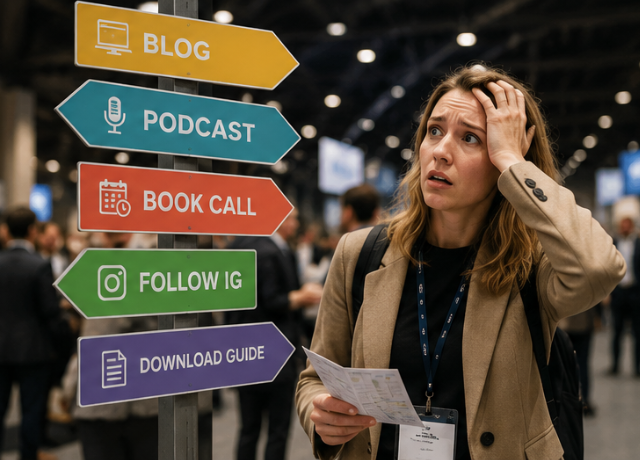
Every additional link you add to an email draws attention away from the primary thing you actually want people to do. In other words, when everything is clickable, nothing is compelling.
There is one exception worth naming (and sending):
A newsletter or digest formatted email, where readers expect multiple pieces of content.
This format itself signals “here are several things worth your attention.” With inboxes more crowded than ever, a well-curated newsletter is actually a welcome arrival for many subscribers with everything worth knowing from you, all in one place.
But for a standard send with a specific goal, like promoting a service, sharing a blog post, or announcing an offer, pick ONE primary action.
Secondary links are fine when they genuinely support the main ask, like linking back to Part 1 when you’re sending Part 2, but they should feel like helpful context rather than competition. When a reader has to decide between three equally prominent buttons or links to click, you’re cutting down on the chances they’ll click on any of them.

Already wishing you could press an easy button to have someone handle all this for you?
Let’s talk!
Your CTA Has to Work for the Click
Even when your email is focused and well-written, a weak call-to-action can stall momentum right at the finish line.
Here are some of the ways we often seen CTAs go wrong:
Vague button copy. “Click here” and “Learn more” are among the least effective CTA phrases because they give readers no information about what they’re getting. Stronger options that tell the reader exactly what to do:
“Get the free checklist,”
“Book a 20-minute call”
“See what’s included”
Burying the CTA. If someone has to scroll to the bottom of a long email to find your link, most of them won’t make it. Your primary CTA should appear early enough that a reader who’s moderately engaged, not just someone who reads every word, can still find it.
A CTA the email didn’t earn. If the first sentence of your email is asking for a sale and you haven’t given readers any reason to buy yet, the click rate is going to show it. The copy leading up to your CTA needs to do the specific job of making the ask feel like a logical next step.
Your Click Rate Improvement Checklist
For B2B and B2C emails, a click rate below 2% on average needs improvement. This can vary by industry, and not all emails need to have a click through to be considered effective, but these stats will give a baseline to work from. As always, testing is the secret to understanding the behavior of your specific audience!
If you’ve identified that your click rate is on the low side, work through this list one step at a time:
➞ Identify your primary CTA and remove or minimize everything competing with it
➞ Move your CTA higher if it’s currently at the bottom of a long email
(Or better yet, include one halfway AND one at the bottom)
➞ Rewrite your CTA copy to describe the specific action or outcome (“Download the guide” vs. “Click here”)
➞ Read your email from the top and ask: does every sentence move the reader toward this one ask?
➞ Check that your subject line and email content are pointing toward the same thing
Click Rates Aren’t the Last Word
Once someone clicks, your focus shifts to what happens on the other end of that link: your landing page, booking form, product page.
Getting the click is a win, but it’s only the beginning of the conversion. If your click rates are healthy but conversions aren’t following, that is your next place to look.
If you’re ready to get expert eyes on your email metrics and the strategy behind them, we can help you make heads or tails of it all. Book a discovery call.


The Top 4 Mistakes We See With Using AI to Repurpose Content
AI makes it easy to repurpose content but there are four mistakes we see

Why Most LinkedIn Newsletters Feel Forgettable (And How To Make Sure Yours Isn’t)
It's easier than ever to start a newsletter on Linkedin. But growing one is
Your Email Branding Matters More Than You Think
Your email content matters a lot. But so does the way your email looks.